Showing posts with label Norwegian Brown Cheese (Brunost). Show all posts

4 March 2013

Maaemo, Oslo – Restaurant Review (Jan '13)


(A more recent review of Maaemo can be found here)

Regular readers of my blog (hello, Mum) will know that I am more than somewhat enamoured by this utterly captivating restaurant. Indeed, Maaemo has been the location for some of the greatest meals of my life, and since it opened just over two years ago its food has unequivocally topped my annual list of the 10 Best Restaurant Dishes.

18 April 2012

Roganic, London – Restaurant Review

Of course, by now you probably all know about Roganic, the London restaurant of Simon Rogan, head chef and owner of the Michelin-starred L'Enclume in Cumbria. Since its opening last summer, Roganic has quickly become one of the darlings of the London restaurant scene. The reviews of the restaurant's particular brand of modern British cuisine have been glowing, and following a recent dinner there, the praise is totally deserved – Roganic dished up one of the best meals I've had in London.

However, it's all change at Roganic now. Head chef Ben Spalding recently made the surprising announcement that he was leaving less than a year into the restaurant's 2-year "pop-up" run. In addition to Spalding's departure, Roganic's front of house team lead by Jon Cannon and Sandia Chang is also changing, with Jon moving to the L'Enclume flagship up north and Sandia starting a new London venture involving hot dogs and champagne.

16 March 2012

Maaemo, Oslo – Restaurant Review (Mar '12)

(You can read a more recent review of Maaemo from me here and here)

This week’s release of the 2012 Michelin Guide brought with it what will surely be the story of the year for the usually quiet Oslo restaurant scene. The latest Guide Rouge for Europe came with the news that Oslo’s restaurant Maaemo had been awarded not one, but two of the French company’s coveted stars. In doing so, Maaemo becomes the only Nordic restaurant in history to have entered the famous guide directly at the two star level. In one fell swoop, a restaurant that has been in existence for just over a year joins a rare club that includes restaurant titans such as Noma, Le Gavroche, Mugaritz, and L’Atelier de Joël Robuchon.

4 March 2012

Mathallen, Oslo – A Taste of Things to Come?

It's finally happening! In just a few months' time Oslo will boast its very own permanent food hall. Norway's capital has lagged behind its Nordic neighbours when it comes to indoor food markets. Stockholm has the wonderful Östermalms and Hötorgshallen food halls, Helsinki boasts the Kauppahalli food market, and Copenhagen now has the new gleaming Torvehallerne food hall. But until recently (and for a few more months yet) Oslo had nowhere permanent to buy speciality produce from local producers.

26 September 2011

Norwegian Baked Cheesecake with Brunost-Pecan Caramel – Recipe


I'm a cheesecake fiend. I absolutely adore the stuff. Not those insipid excuses made with gelatine, mind; I can't abide those. No, what I usually crave is a proper Nuuu Yoik baked cheesecake, with its creamy sour tang. Nothing else will do.

2 September 2011

Another Visit to Maaemo, Oslo – Restaurant Review


(You can read more recent reviews of Maaemo here, here and here)

Well, this is becoming quite the habit. But I just can't help it. Regular readers will know that I've become totally smitten with Maaemo, the ground-breaking Oslo restaurant that has completely redefined the concept of Norwegian cuisine. My previous meals at the restaurant (see here and here) left me in no doubt that I had truly tasted some of the best cooking of my life – a bold statement, but Maaemo really is up there with the very best. Indeed, such is my fascination with the restaurant that I even interviewed some of the people behind it to learn more about what they are trying to achieve. Have a look at these links if you'd like to learn more on the background of the restaurant and the people behind it.

24 November 2010

Rømmevafler (Sour Cream Waffles) – Recipe

Little Miss Nibbler (age four years and one week) is learning about hibernation in her kindergarten at the moment. I arrive home to her regaling me with vague tales of slumbering bears and snoozing hedgehogs. I listen patiently, as I've learnt to do, but occasionally my mind wanders, to be filled with fantastical thoughts of spending the winter cocooned under my duvet in a reduced metabolic state. In preparation for this self-imposed lethargy, the body must prepare itself with calories. Lots of calories! Not that I really need the extra insulation, but there is one dish that would fit the bill perfectly: rømmevafler, or Norwegian sour cream waffles. Short of mainlining butter I can't think of a more efficient calorie delivery system, and as a pleasant side effect these waffles are utterly delicious.

Waffles can be found all over Norway and they are eaten like they're going out of fashion, typically as an afternoon treat. There are quite a few different recipes out there, but the two main types are those made with and without sour cream, some even add a touch of cardamom to the batter. Unlike their distant American relative, these waffles are relatively thin (about ⅓-inch thick) and are typically made in waffle irons that produce heart-shaped segments with shallow indentations. However, the real difference is in the batter. Norwegian waffles are richer and slightly denser – all the better for filling you up after a hard day's walking or skiing in the mountains – and sour cream waffles in particular are rib-stickingly good.

Norwegian waffles are typically eaten with brunost (Norwegian brown cheese) or jam, the latter possibly accompanied by some extra sour cream, if what's in the waffles isn't already enough for you. In the photo above you'll see a fork and a knife, however true Norwegians eat their waffles with their hands. You just tear off a segment and fold it in two so the filling doesn't fall out.

I've mentioned before that most of the baking in our household is done by Mrs. Nibbler, and as a true Norwegian she is almost obsessive about baked goods. This version of rømmevafler comes from Mrs. Nibbler's magic book of family recipes, but it's a fairly standard one. These should really be made with Norwegian sour cream (seterrømme), which is quite thick, almost like crème fraîche. But if you can't get hold of some then I've included another equally delicious waffle recipe. Be warned though; one waffle is never enough, but two will leave you in a food-induced coma on the sofa.
Rømmevafler – Ingredients (makes a few waffles)
  • 500 ml seterrømme (thick Norwegian sour cream, 35% fat)
  • 300 ml plain flour
  • 150 ml water
  • 2 tbsp melted butter
  • pinch of salt
  • 1 tsp baking powder
Regular Waffles – Ingredients
  • 500 ml buttermilk
  • 2 eggs
  • 150 g plain flour
  • 50 g unsalted butter, melted
  • 1 tbsp sugar
  • 1 tsp baking powder
Method (for both varieties)
  1. Whisk all the ingredients together until you get a smooth batter and leave to rest for 10 minutes
  2. Heat up a waffle iron
  3. Lightly brush the waffle iron with butter
  4. Using a ladle pour the batter into the waffle iron and leave for 2-3 minutes until they are cooked
  5. Remove waffle and eat with dollops of strawberry jam, brown cheese, or even maple syrup!
So there you go. If you're after something warm and sweet and cosseting, perhaps after a day spent outdoors, or indeed if you are planning on going into hibernation, then why not give these waffles a try. You won't be disappointed.

10 October 2010

Fru Ingrid's Brunost Is (Brown Cheese Ice Cream) - Recipe


"Brunost ice cream. Are you sure?"

Oh yes.

"You're going to put brown goat's cheese in ... er ... ice cream?"

Indeed, I am.

"And then eat it?"

You bet.

I can't take all the credit for this unusual, but insanely delicious, invention. In fact, I can't take any credit, as it is the creation of Ingrid Hov Lunde from the wonderful Røisheim Inn in Bøverdalen. I admit I was more than a touch sceptical when this dish was first presented to me there, but Fru Ingrid had prepared a truly astounding dessert of marinated wild berries that was served with brunost ice cream. It was utterly gorgeous.

For those that don't know, brunost (also known as geitost) is a traditional Norwegian cheese that is made from the whey of goats' milk that has been boiled until the sugars have caramelised, giving it its distinctive brown colour. It has an unusual salty and sweet flavour to it, and tastes nothing like cheese (for more on brunost you can read my earlier post here).

The more I thought about it, the more I realised how perfect the confluence of these flavours is: vanilla ice cream mixed with salty, caramelised 'cheese', with notes of burnt sugar and even the merest hint of coffee. In fact, it is very similar to the well-established and equally delicious salted caramel ice cream. So when I received a belated birthday gift of a much wished-for ice cream machine, I knew exactly what I was going to attempt to make first.
Ingrid has her own recipe for brunost ice cream in her excellent cookbook, Fru Ingrid på Røisheim, but I decided to improvise and make my own, using a standard vanilla ice cream recipe as the base. I used an extra rich brunost called stølstype, which is a dark, traditional style of brunost and resembles that which would have been made on old seter (a summer farm house). Ingrid also lists the recipe for the marinated berries I originally had with it, but I skipped that this time, preferring the pure hit of brunost ice cream instead. It's quite rich, so a little goes a long way. For variation you could also add some crushed green or brown cardamom pods to the milk at the steeping stage.

Ingredients (makes about 1ltr of ice cream)
  • 250ml whole milk
  • 200ml cream (around 40% fat)
  • 5 egg yolks
  • 130g caster sugar
  • 100-120g brunost (Norwegian brown cheese)
  • ½ a vanilla pod
Method
  1. Put the milk and cream into a saucepan and add the sliced brunost to it
  2. Cut the vanilla pod in half lengthwise, scrape out the seeds and place seeds and pod into the milk/cream
  3. Gently heat the milk/cream until it has almost boiled and the brunost has melted. Stir constantly.
  4. Remove from the heat and leave for half an hour to let the vanilla infuse into the milk
  5. Meanwhile, beat the egg yolk and the sugar until pale and fluffy
  6. Sieve the milk/cream mix and slowly pour onto the beaten egg yolks, stirring constantly
  7. Place the mixture into a clean saucepan and heat gently until it has almost boiled, stirring constantly so the mixture doesn't curdle. The custard should thicken and it is ready when it coats the back of a wooden spoon.
  8. Place the mixture into a pouring jug and put in the fridge until it is cool
  9. Slowly pour the mixture into an ice cream machine (make sure you have turned the machine on before you start pouring) and churn until almost frozen but still smooth (around 30 minutes)
  10. Eat straight away or keep in freezer until needed

7 October 2010

Matstreif Food Festival, Norway


One of Norway's largest annual food festivals, Matstreif, took place in Oslo the other week. This is the sixth year it has been run, and such was the popularity of last year's festival (over 120,000 people attended last year) that this year it was held over three days.

So it was that I found myself on a chilly October day in front of the austere looking City Hall, with Oslo Fjord acting as a beautiful backdrop, ready for some culinary exploration. The festival is sponsored by Innovation Norway, who help promote Norwegian business and, as such, the festival is a real showcase of the very best of Norwegian cuisine.

I only had a couple of hours there, which was nowhere near enough time to fully explore everything. This was a truly huge festival and I could have easily spent a whole day wandering round and stuffing my face. There was so much to see and do and eat. Artisan producers from all round the country were represented, there were live demonstrations from chefs, presentations, competitions and, of course, lots and lots of fantastic Norwegian food to try. Many of the same producers that attended the Oslo Farmers' Market were there and they were joined by dozens of others. In total there were about 140 exhibitors and over 3,000 different products.

So here's a quick snapshot of the food festival. It is by no means an exhaustive list, but I think I managed to capture most of the main highlights.

Here's a burger stand Norwegian style: elk burgers from Ommang Søndre, a bio-dynamic farm in Løten! I've eaten elk before so I thought I'd save myself for something else. But if you're wondering what it tastes like then think of a less gamey tasting venison with the texture of very lean beef.

Berry Syrups from Linnea Finnskogen
Lots of organic vegetables:

Striped beetroots, they look so beautiful!
I spotted what I thought was smoked trout and gleefully popped some in my mouth. I regretted it instantly. It turned out that this wasn't smoked trout, but was, instead, the infamous rakfisk, aka rotten fish. And it was... IN MY MOUTH. Rakfisk is fermented trout, and apparently people have gone blind and even been killed by badly prepared rakfisk. The sweet lady serving it smiled at me and expectantly asked me in Norwegian if I liked it. I didn't have the heart to say otherwise, so I swallowed the cold flaccid fish, grinned like a lunatic and said it was delicious, and then hurried to the fresh-pressed apple juice stall to try and get rid of the rancid taste in my mouth. It was singularly the worst thing I have eaten, with a noxious taste of rotten flesh and ammonia, and a smell like it forgot to wipe.

Rakfisk is perhaps one of Norway's oldest foods. The first record of it dates back to 1348, but the method of preserving fish by fermentation dates back thousands of years. Fish, usually trout but sometimes char or herring, is gutted, washed and soaked in vinegar for half an hour. The fish is then salted and placed in a bucket with a weighted lid for up to three months at around 4°C. In other words, the fish is allowed to rot.

Today, rakfisk is enjoying a resurgence in Norway, and it is considered quite fashionable to have rakfisk parties, where the fish is consumed with potatoes, onions, sour cream, flatbread, and plenty of akevitt. I think it's one of those foods that you have to have grown up eating in order to like it, as Norwegians seem to really enjoy it. It reminded me of the BBC TV show "Cooking in the Danger Zone", where the host, Stefan Gates, visits the Inuit in the Arctic circle and eats igunaq, which is rotten/fermented walrus. The sight of young Inuit kids gleefully eating igunaq made an amusing contrast to Gates, who was doing everything in his power not to throw up.

Rakfisk - looks so tasty, but packs quite a punch

More familiar territory now with some klippfisk, or salt cod. Although being one of the country's largest exports historically, it is not often eaten in Norway. For a quick and tasty klippfisk recipe, see here.
Klippfisk (salt cod)
I won't get into the whole whaling debate, but suffice it to say that Norway is a proud whaling nation, and there was plenty of whale meat on offer at the food festival. I tried some smoked whale meat, which was quite pleasant. It had a texture like tuna, with an unusual flavour of mildly smoked beef and fish. It's probably not something I'd jump at to eat again, but it was interesting nonetheless.

"Whale Wok": stir-fried whale
There were plenty of stalls that were cooking some amazing dishes, which created such a wonderful mix of aromas.
 
A hearty autumn stew with grilled pork loin
For my first lunch I had this delightful little plate of food, which comprised of a starter of pike mousse and smoked salmon roulade, meltingly tender roast pork from Brødr. Ringstad with herb butter and mashed potatoes, and a mousse of crowberries, blueberries and nýr (a sort of mild fresh cheese, like ricotta) from Grøndalen farm.

My second lunch was equally delicious; gratinated scallops served in their shells piping hot from the grill.


It doesn't get much better than Norwegian seafood, and there was plenty on display, including one of my favourites: arctic char from Vesterålen in the north of Norway.

Crab claws
Wonderfully sweet mussels from Snadder og Snaskum. Stay tuned for a simple pasta recipe in which I use these delicious molluscs.


This fella scared the life out of me. Not sure where it was caught though.

Come on in, the water's lovely!
Here is some cured mountain goat leg from Fjellgeit BA in north Gudbrandsdalen. Such is the craftsmanship that if it were 20 degrees warmer we could almost be in Spain eating jamón Ibérico.

Vinegars, jams, and honey
And now one of my favourites: warm svele fresh from the griddle, made by Anne Karins from Fagerstrand. Svele are thick, fluffy pancakes that are made with flour, eggs, sugar, buttermilk, and baking soda. They originate from the west coast of Norway, and if you ever take a ferry across one of the many fjords in this part of the country, you will invariably be served svele. Here they were served with sour cream and a blueberry jam. Soo yummy; I could have eaten many, many more.

Warm svele with sour cream and blueberry jam
Finally, what better to go with the svele than a luxuriously thick, dark espresso.

By all accounts, it seems that Matstreif 2010 was a resounding success, and the expanded format this year was a very welcome addition. This food festival was just the sort of thing that makes me so happy: seeing knowledgeable local producers and their delicious bounty of local food. Norwegian food often gets a bad reputation, and yes, sometimes it is justified, but I left Matstreif excited with the knowledge that with producers and products like these, Norway has so much good food to be proud about.

1 October 2010

Røisheim, Norway

Røisheim
Autumn is such a magical time in Norway. Nature begins its metamorphosis in advance of the rapidly approaching winter; great swathes of landscape start to glisten in shades of crimson, gold, and russet as the foliage starts to change. The last hardy berries of the bountiful summer months still cling on to branches for dear life, and alien-like fungi start sprouting on the mossy forest floor.

If summer in Norway is spent on the coast, then autumn is for the mountains. So it was that Mrs. Nibbler and I found ourselves alone (the Nibbler kids were happily ensconced with the grandparents) on the five hour drive north from Oslo towards the Bøverdalen valley, in the foothills of the majestic Jotunheimen mountains. The name in English roughly translates as "The Home of the Giants" and it is this mountain range that contains the mighty Galdhøpiggen, which at 2,469m is Northern Europe's highest peak. When we were there, its snow-capped summit was hiding demurely behind a blanket of clouds, but you are always aware of its looming presence.
Galdhøpiggen in the distance, shrouded in cloud
But we were not here to just admire the mountains. We're here to spoil ourselves with a stay at Røisheim, a small and rather unique hotel. Røisheim is an 18th century coaching inn that served as natural resting point for travellers along the formidable Sognefjellsveien, the highest mountain pass in Europe, which starts in Lom and travels south west over the Sognefjell mountains and into the village of Gaupne. From May to September every year Røisheim opens its doors to the public, who get to stay in one of its twenty unique rooms.

The term 'hotel' doesn't really do this place justice at all. In fact, the term 'time machine' would be more appropriate. The buildings of Røisheim appear to have changed little in almost two centuries. The tar painted wooden beams of the buildings seem as timeless and solid as the nearby mountains. Indeed, the sod roofs of the buildings give the appearance that Røisheim has magically grown out of the very land it sits on. Inside, it is no different; antique furniture, old books, and traditional Norwegian artefacts abound. Norwegian luminaries such as Edvard Grieg, Henrik Ibsen, Fritz Thaulow, and Gerhard Munthe have all stayed at Røisheim and you sense the weight of their presence all around. Røisheim is run by the ever-smiling husband and wife team of Haavard and Ingrid Hov Lunde, and their warm hospitality makes you feel like a guest of honour in their own home.
Røisheim, 1892
Røisheim, 2010
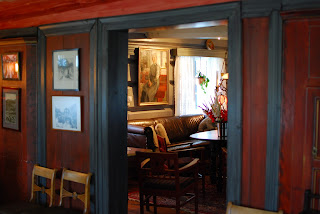
The main louge


Each room is unique, some have their own fireplaces, and all have himmelseng (traditional four-posted beds) and badestamp (old fashioned wooden bathtubs). Our room was located in the second oldest building (the oldest dates back to the 16th century) at Røisheim, and it entailed a precarious walk up some rickety steps to get in. Once inside though, you have the feeling of being in a giant, luxurious treehouse.
Our 'treehouse' at Røisheim


You stay at Røisheim on a half-board basis, and at 7:30pm sharp a quaint bell rings out signalling dinner. We all filed into a small, but airy, dining room to find our individual tables labelled with rustic name tags. There's just one menu on offer here - gracious hostess Fru Ingrid prepares a daily changing five-course menu that incorporates mostly local ingredients. At dinner, avuncular host Haavard dons traditional Norwegian dress, which includes leather trousers and traditional hunting knife, and plays the role of sommelier. We opted for the paired wine menu that included a rather interesting Italian wine (I forget which type) that is made exclusively for the hotel.

We started with a light and fresh shellfish salad with crayfish that came with a cheese wafer, and sour cream and chervil sauces.

Next was house-smoked blackcurrant marinated halibut with salad leaves and chervil pesto. This dish packed quite a punch; the fish was intensely smokey and the tart blackcurrant balanced nicely with the rich, fatty halibut.

Then, a palate cleanser of some mango sorbet. Maybe I'm being a bit harsh but, although pleasant enough, I felt this was somewhat out of place. Given that the rest of the meal was so intensely Nordic and the setting so steeped in history, it just seemed a tad incongruent to be eating exotic, imported mangoes. Surely something local and seasonal, such as a berry sorbet, would have been much more appropriate.

The main course, though, was a masterpiece - a picture of autumn on a plate; reindeer fillet cooked perfectly pink was served with sautéed wild mushrooms, a cranberry marinated poached pear, nut roasted potato, and a creamy game sauce. I often forget that reindeer is considered quite an exotic meat outside Scandinavia (here in Norway it is quite common), but if you haven't tasted it before you're missing out on a real treat - think of a more tender, less gamey, and slightly sweeter tasting version of venison. It is a very lean meat, so you have to be careful not to dry it out, but here it was perfectly moist. The marinated pear provided some welcome acidity that was balanced by the creamy sauce. It actually reminded me of the venison dish I had at Noma, which was served with some of the various things a deer might come across in its natural habitat, and was every bit as good in my opinion.

On to the cheese course next. Here, local cheeses were served with some balsamic glaze and honey. The dark square cheese on the right was an amazing brunost (Norwegian brown cheese) - it was full of glorious caramel and coffee flavours, and was probably the best example of a geitost (brown cheese made with goats milk) I have ever tried.

Finally, we continued on the brown cheese theme with a dessert of homemade brunost ice cream with marinated berries. I was a tad sceptical when I first heard the ice cream described to me, but it turned out to be just heavenly. If you think about it, with its sweet and salty notes, brunost lends itself wonderfully to a dessert like this, and the end result was not dissimilar to a salted caramel ice cream (so good was it, that I even tried to make this ice cream a few weeks later). The berries were perfectly ripe and each one seemed to just explode with bursts of intense flavour in the mouth. This was such a delicious dessert. To round off the evening, we retreated to the lounge for coffee by the fireplace.


Leftovers from dinner
The next morning we awoke refreshed after a long and deep sleep (it's so quiet up here). After a lazy bath in the badestamp, we arrived for breakfast. A wonderful, traditional Norwegian spread had been laid out that included fresh bread from the bakery in nearby Lom, local cheeses, gravlaks, herring, homemade jams (including a delicious cloudberry jam), and mueslis.


Røisheim is such a magical place, and if you're looking for a quintessential Norwegian experience that is steeped in history, then a stay here should not be missed. It serves as an excellent stopover if you're heading from Oslo to the great fjords of the West Coast, or indeed as a great base from which to explore the Jotunheimen mountains. Mrs. Nibbler and I had such a fantastically relaxing weekend at Røisheim, cocooned away in its simple luxury. We left with our batteries recharged, a spring in our steps, and ready to face life anew.

Food:         7 / 10
Service:      8 / 10
Ambiance:  10 / 10

Røisheim
Røisheim Hotel
N-2687 Bøverdalen
Norway
Tel: +47 61 21 20 31