14 July 2010

Quai des Artistes, Monte-Carlo - Restaurant Review

I came across these pictures from my Monaco trip the other day lurking on my camera's SD card and I thought it would be worth posting something about them. Following on from the battering our wallets had taken at Restaurant Joël Robuchon the night before, we decided to go for something a little more low key for our dinner that night.

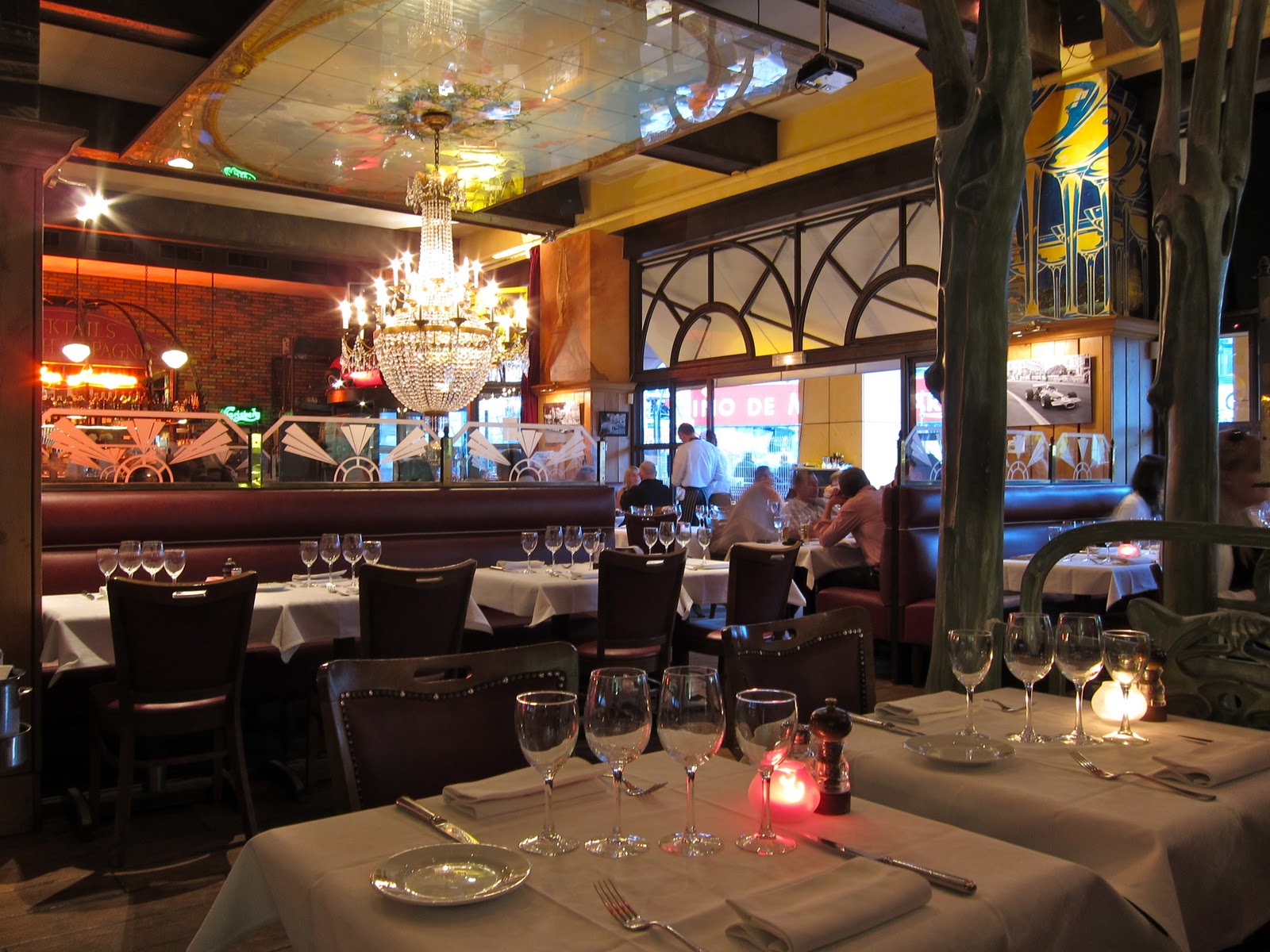
Eating out in Monaco can be a bit of challenge at times. Decent restaurants tend to be phenomenally expensive while the cheaper ones seem to serve mediocre fayre catered to tourists. Quai des Artistes strikes a middle ground. Although still fairly pricey, it falls into the mid-price range bracket of Monaco restaurants. The restaurant is modelled on a Parisian brasserie and is nicely located on the harbour just next to the raucous Stars'N'Bars restaurant. The interior is very pleasant, although it borders on the pastiche and is a touch clichéd; you sort of imagine that if Disney made a French brasserie that this is how it would look; leather banquettes, a large central chandelier and even an old Paris metro sign dominate the room. But the restaurant just about manages to carry off the look.


The extensive menu serves a wide variety of hearty brasserie food. Starters include, among other things, classics such as escargot, moules marinière, terrines and soups. Mains are dominated by grilled fish and meat. Everything on the menu here sounds good and it was genuinely a tough choice to decide.

To start with I had gratinated queen scallops which came served in the shell. The scallops were perfectly cooked in a cream and wine sauce, while the breadcrumb crust was satisfyingly crispy and cheesy. 
Gratinated Scallops
The main course was a fantastic piece of entrecôte steak cooked medium-rare with bernaise sauce. Accompanying this were pommes dauphinoise and a green salad. The steak was really good, perfectly cooked and well-rested, and nicely charred on the outside with a juicy, grassy taste. The creamy dauphinoise potatoes had a nice garlicy aroma to them and the green salad was, well, just salad, but perfect for mopping up the juices. This has to be one of my favourite food combinations of all time; very simple, but amazing when done well, and here it was done very well indeed.

Entrecôte steak with pommes dauphinoise and green salad
For dessert I had a strawberry mille-feuille, which although good was nothing special. The mille-feuille was a little on the chewy side but the strawberries were perfectly ripe and the coulis was not overly sweet.

Strawberry mille-feuille
The bill per person came to around €140 per person, including coffee and some rather decent red wine. This was probably more than I was expecting to pay for this sort of food, but as I've mentioned before there aren't really any decent 'cheap' restaurants in Monaco, so in this context Quai des Artistes seems reasonably priced for such an agreeable meal. I was also impressed with the quality of service given that it was the middle of the Grand Prix weekend. All in all, Quai des Artistes is a thoroughly decent place to while away the evening over some good French comfort food and some decent wine.

Food:        7 / 10
Service:     7 / 10
Ambiance: 8 / 10

Quai des Artistes
4 quai Antoine 1er
Monte-Carlo 98 000
Monaco
Tel: +377 97 97 97 77

12 July 2010

Solsiden, Oslo - Restaurant Review

Its been wonderfully sunny here in Oslo these last few days and few know how to appreciate good weather more than the Norwegians. The summer here is of the fleeting, blink-and-you-miss-it type, and is all the more sweeter for it. Memories of the bitterly cold winters are never too far from the mind, so when the sun comes out the whole of Oslo goes out to play. I love this time of year; many Oslo natives are away spending the summer in their cabins so the city feels extra quiet, and when the clouds part we get to enjoy balmy 20-hour sunshine filled days.

Naturally, in weather like this, one tends to want to eat something fresh and light. So it is that we find ourselves at the Oslo Harbour in the shadow of the medieval Akershus Castle on our way to Solsiden restaurant for some of their famed Norwegian seafood.

Solsiden (Norwegian for "The Sunny Side") is open for just 4 months of the year from May to September. The restaurant has a large and airy indoor dining room with huge windows that are left open to the breeze to reveal magnificent views over Oslo Fjord. There is also an outdoor terrace which serves a reduced menu. If you stay late enough Solsiden is one of the best places to see the sunsets over Oslo harbour.

View of Oslo Fjord from the restaurant
Appropriately, given the restaurant's location on the shores of the Oslo Fjord, it serves only seafood. And what seafood it is! I truly believe that Norway possesses some of the best seafood in the world. But sadly it is all too often overlooked for the processed junk that unfortunately constitutes more and more of the typical Norwegian diet. Fortunately, Solsiden "gets it" - fantastically fresh seafood, cooked and served simply - always a winning formula in my book. Their menu is a seafood lovers dream - an à la carte menu comprising of things like scallops, lobster, turbot and trout, and they also have changing daily three- and seven-course menus.

Solsiden's specialty though is their shellfish platter. A huge plate of towering shellfish that includes oysters, scallops, crayfish, brown crab, mussels, prawns, langoustines, king crab, and lobster. Served over ice with plenty of lemon wedges - a veritable feast of crustacea for two. Crazily we didn't order this (I couldn't get Mrs Nibbler to partake, but next time) but you can see pictures of it here and here, truly amazing.

Instead, I opted for turbot, which came pan-fired with potato and horseradish purée, sauteed carrots and green beans, and creamed lobster sauce. Turbot is one of my favourite fish - it's the Rolls-Royce of the seafood world. Here, it was perfectly cooked; firm white flesh that tasted clean and fresh with a velvety and rich lobster sauce. The mashed potatoes accompanying it were good too; smooth and buttery with a nice pepperiness added by the horseradish. This was all washed down with some fine cold Paul Prieur & Fils Sancerre (interestingly the restaurant also has it own Chablis: Cuvée Solsiden).

Mrs Nibbler opted for a main course from the daily specials board - spotted wolffish (a terrifyingly primitive looking fish that can grow to over 6ft, which lives in these cold northern waters) that came with pommes purée, a lobster reduction, and a radish and baby spinach salad. She kindly let me have a bite and I found the lean pearly white fish to be firm with a mild, sweet flavour, almost like lobster. It was really delicious.

My only complaint was one of portioning - the balance of the dishes seemed to lie to heavily toward the (cheaper) non-fish accompaniments. Comically, Mrs Nibbler's wolffish seemed to be hidden under the salad. Now, Mrs Nibbler is quite fond of her veg and liked the portioning as it was in contrast to many restaurants we've been to where something like the pommes purée would often be a tiny smear at one end of the plate. However, either a larger portion of fish or less veg is definitely needed, especially as these mains were around £30 each.

Our dining companions had lobster served with house-made mayonnaise and a simple green salad, and a dish of steamed mussels with parsley, white wine, and garlic. I didn't try these but they looked and smelt amazing.
Fried turbot with potato and horseradish purée, creamed lobster sauce
Steamed mussels with parsley, white wine, and garlic
Lobster with mayo and salad
Spot the Spotted Wolffish
Service was pretty good too although it could be more attentive, especially when it gets busy. But on the whole the waitstaff were friendly and enthusiastic, going over the day's specials and helpfully answering any questions we had. We had the two young Nibbler girls in tow and they are at an age where taking them to restaurants can be a bit, er, challenging shall we say. We were the only people there with small kids but there was no problem at all accommodating them. My youngest got a high chair and some bread to nibble on, and my eldest was served her meal of trout with Orzo pasta and vegetables first, before the adults got their food - a real sign that the restaurant understands the challenges of eating out with small kids.
View from our table
I didn't see the total bill as this was a birthday treat, but pricewise it's at the mid-range of Oslo restaurants (which I guess puts it at the expensive range of restaurants outside Scandinavia). Starters seemed to be around the NKr 150 (£15) mark and mains around NKr 250-300 (£25-30). Their famous shellfish platter is NKr 635 (£65) for two. Wine was around NKr. 100 (£10) a glass. It's well worth it though. When the weather is nice, Solsiden is a wonderful place to while away an afternoon. You can eat some wonderful seafood, drink good wine, and generally watch the world go by - and of course there's that view.

Food:           7 / 10
Service:       7 / 10
Ambiance:   8 / 10

Solsiden
Søndre Akershus Kai 34
0150 Oslo, Norway
Tel: +47 22 33 36 30

7 July 2010

Vanilla-Scented Halibut with Asparagus and Hollandaise - Recipe

After the recent flurry of blog posts from my recent trip to Japan I thought it might be time to write about some things closer to home, namely halibut and a simple recipe for it.

Halibut is a rather strange fish. The largest flatfish in the Atlantic, it starts out in life swimming upright like a regular fish with an eye on each side of its head and then for some strange reason decides it wants to swim on its side, with one eye mysteriously migrating over to meet its twin on the upward facing side. It is a fish that is surrounded in mysticism, its English name coming from an amalgamation of "holy" and "butt" (no sniggering at the back) - a "butt" being a flatfish and "holy" in the sense that it was typically eaten on holy days when meat could not be consumed. It has been a part of Scandinavian cuisine for thousands of years, in fact 6,000 year old drawings of halibut have been discovered in caves near Alta, way up in northern Norway.

Wild Halibut in Norway is fantastic at this time of year but Norwegian farmed halibut is wonderful too and a more sustainable alternative, it even featured as a key ingredient in this year's Bocuse d'Or. Luckily I live very close to the magnificent Fjelberg Fisk & Vilt fishmonger which, although pricey, sells some of Oslo's finest seafood. So when I needed to rustle up a quick supper for the Nibbler family I turned to a very simple but interesting recipe for halibut from one of my favourite Norwegian foodies, Andreas Viestad. This recipe for halibut features in his excellent book of modern Scandinavian cooking, Kitchen of Light.

I must admit I've been somewhat skeptical about using vanilla with fish and this is the first time I have tried such a combination. But once cooked the vanilla flavour really mellows out with none of that cloying taste that an overload of vanilla often provides. It really complemented the meaty halibut very well. It also provided me with an easy way to sell the dish to the eldest Nibbler girl - she took one sniff of the dish before it went in the oven and said it smelt just like ice cream and couldn't wait to try some.

OK, so its a little late in the season for asparagus, but I found some nice looking imported ones and I don't need much persuading to make hollandaise sauce to go along with them. I'll fess up that the sauce did split on me, but a dash of cold water and some furious whisking rescued it nicely. The reduced cooking juices made a simple but effective sauce, although the fish is so juicy it doesn't really need it.


Ingredients (2-4 portions, depending on how hungry you are)
700g halibut steak
1/2 vanilla pod
Small glass of dry white wine
8 tbsp clarified butter
2 egg yolks
2 tbsp lemon juice
500g asparagus
Sea Salt and freshly ground pepper

Method
1. Preheat the oven to 200 Celsius
2. Rinse the fish and pat dry with paper towels
3. Split the vanilla pod and rub the seeds evenly over the fish
4. Place fish in an ovenproof dish and add the wine and season with salt and pepper
5. Cover fish tightly with tin foil and place in the oven for 20 to 30 minutes until cooked
6. While the fish is cooking prepare the hollandaise sauce by whisking the egg yolks, lemon juice and salt in a bain marie while slowly adding the clarified butter. Set aside and keep warm
7. Cook the asparagus in salter boiling water and season with salt
8. When the fish is cooked place it on warmed plates and reduce the cooking liquid in a pan
9. Serve the fish with the asparagus and hollandaise and drizzle over the reduced cooking juices

5 July 2010

Inakaya, Tokyo - Restaurant Review

We were supposed to have sushi. However, as I mentioned in my last post, finding places in Tokyo was proving to be trickier than I had imagined. Instead, after wandering around the Roppongi area of Tokyo for what seemed like ages, our hunger pangs got the better of us and we stumbled into the nearest restaurant. The restaurant in question turned out to be a small robatayaki restaurant called Inakaya.

I wasn't quite sure what to expect, and I was somewhat apprehensive given that a) the restaurant was deserted, b) we were in the most touristy/expat area of town, and c) there was no menu or price list to be found. We entered into what looked like quite a traditional and spartan dining room, the walls were adorned with small banners and other Japanese artefacts like fans, and decorative wooden paddles that are used to serve the food. We were greeted by raucous cries of "irasshaimase" from the chefs and waiters. I never know how I'm supposed to reply so we all just smile and nod and generally stand around looking like clueless gaijin.

We were ushered to one of the two u-shaped tables that seat about 10-12 people each. Each table surrounds a charcoal grill attended to by a chef kneeling on an elevated bench. In front of the chef was a mouth-watering array of fresh produce such as asparagus, mushrooms, Kobe beef, prawns, mushrooms, and fish. I gather that robatayaki is supposed to recreate the atmosphere of a traditional farmhouse with guests seated around the open hearth.


The waiters spoke some English and instructed us to pick from the dazzling array of produce in front of us. We were like kids in a candy shop pointing at almost everything. Ice cold, crisp Japanese beer and a little delicious appetiser of ginkgo nuts and pickles arrived. Immediately, I could tell we were in good hands and could begin to relax.

The waiter would then loudly shout out each order to the chef which was then repeated by the rest of the wait staff in case the chef, for reasons I can't fathom, hadn't heard it the first time. The chef then repeated the order back at similar volume and the process was repeated for every dish and drink. It was an fantastically fun and energetic atmosphere in which to eat, not a place for a quiet night.
 

The chef then set about meticulously preparing the food he was about to grill. I watched as he carefully trimmed some asparagus and cut them to identical lengths. These were then threaded onto a skewer and grilled. Once cooked the food is passed to you on long wooden paddles, accompanied of course by more shouting. The asparagus was wonderful; crunchy, sweet and amazingly fresh. Grilled shiitake mushrooms were perfectly seasoned and slicked with a wonderful umami rich sauce. Corn on the cob was crisp, sweet and juicy with a pleasing char from the grill. Mild red chili peppers were roasted whole. A solitary giant prawn that was super fresh, and tender. Cubes of skewered Kobe beef were served with fresh grated wasabi and garlic puree that is mixed into a dipping sauce. I adore Kobe beef and the Japanese stuff is streets ahead of its American and Australian Wagyu counterparts. The beef here was absurdly good, it was richly marbled which, when cooked, rendered it succulent and it really did just melt in the mouth.

All of a sudden the chef got up and left swiftly to be replaced by another. For a second I thought he was off for a smoke/tea/bathroom break, but in fact no, apparently it is traditional at a robatayaki restaurant to change the chef at the end of the meal. We finished with thin slices of grilled onion which was slicked with the same sauce as the mushrooms. I had watched as the chef had sliced into what looked like a perfect onion only to reject it for another one due to some minor imperceptible imperfection. As I've mentioned before about my dining experiences in Tokyo, the sheer quality of produce and attention to detail is unbelievable. Finally to finish the meal was a simple, perfect kiwi. Bliss.

Grilled prawn

Kobe beef skewer

Grating fresh wasabi

Chef serving out food
The damage came to about £100 a head with beer, which seems steep given the amount of food we had but, luckily for me, I was on an expense account. I suppose you are also paying for the full undivided attention of your own chef and a small army of waiters - we were in a group of 5 which put the staff/guest ratio at over 2 staff for each guest, way more than a Michelin 3-star restaurant.

I later found out that Inakaya is a chain of restaurants with 3 restaurants in Tokyo and one in New York City, but it doesn't feel like that at all. The one we went to in Roppongi felt small and intimate and all the staff were super efficient and friendly. The atmosphere is quite raucous but its a lot of fun so this is definitely a place to go in large groups and not for a first date. Yes, this Inakaya is in a 'touristy' area and yes it's a touch overpriced, but with the freshness and quality of the produce and the enthusiastic service, who can complain?


Food:          8 / 10
Service:       9 / 10
Ambiance:   9 / 10

5-3-4 Roppongi Minato-ku
Tokyo, Japan

1 July 2010

Bird Land, Tokyo - Restaurant Review

I'm lost again. Tokyo has to be one of the most challenging places to get around - there are no street names here, just block numbers and buildings numbered in the order they were built. Quirky to say the least, and very frustrating when I'm trying to find a restaurant and about to go hypoglycaemic. At least I'm in good company as on numerous occasions I saw lots of Tokyoites just as hopelessly lost as me. Eventually, thanks to the iPhone's trusty map feature, we find our destination in the basement of what looks like an apartment building in the upscale Ginza area of Tokyo. The restaurant in question is Bird Land, and despite the strange name is one of the hottest tickets around at the moment. It is widely considered to be the gold standard of yakitori restaurants and just gained its first Michelin-star in the latest version of the Tokyo guide (although it can be argued that Michelin stars are somewhat redundant for Japanese food in Japan).


We arrived to a packed restaurant at around 7pm and with no reservation managed to get a couple of seats at the large u-shaped bar area, facing a large central grill where the main event was being prepared. I gather that Birdland only takes same-day reservations from noon and it's super popular, so we were quite lucky to be seated so quickly. Amazingly for Tokyo their website takes reservations online in English.

Yakitori is a simple type of Japanese food which basically consists of grilled chicken on a skewer. Sounds pretty tame, maybe a tad boring, no? I suppose it's the Japanese equivalent of a kebab joint with booze, where salarymen spend the evening after work drinking rotgut sake and eating grilled chicken. However, here at Bird Land, the art of yakitori is taken to another level entirely and the attention to detail is simply phenomenal. The restaurant is owned and run by Toshihiro Wada. He first set up shop over 20 years ago in the back alleys of Tokyo's Asagaya area and quickly gained a name for himself as one of the best yakitori chefs around. In 2002 he moved to the site of the current restaurant, which is surprisingly light and airy given is underground locale. At one end of the large wooden bar are smaller tables for diners. The whole atmosphere feels very relaxed and intimate. The clientele included salarymen having a bite to eat after work and couples on dates.

Master Toshihiro Wada at the grill
The chicken that Wada-san uses here is something really special. They are free-range Okukuji shamo (gamecocks), reared in the mountains of northwest Ibaraki prefecture. Their meat is soft, aromatic and stunningly fresh. So fresh in fact that you can eat it raw, and it is a common starter here at Bird Land where its called shamo sashimi and is served with wasabi and a sweetish shoyu sauce. The yakitori skewers are grilled over Bincho charcoal from the Kii Peninsula, which is highly rated for the even, constant heat it generates.

There are two omakase (chef's) menus costing JPY 6,000 and 8,000 (£45-60) but we opted to go a la carte and tried a selection of things, galline and otherwise. First up I tried grilled chicken fillet which was served simply with salt and freshly grated wasabi. The chicken was lightly charred and dotted with small blobs of wasabi. Alarmingly it was cooked rare but, so far in Japan I've learnt to put my prejudices to one side and assume they know best. It was monumentally good.

They also had a few dishes that combined traditional Japanese yakitori with European flavours. A dish of grilled chicken with basil and chervil was wonderfully fresh and light, and seemed new and strange after having only Japanese food during my week-long visit. Shiitake mushrooms were wonderful and smokey - how can something as simple as a grilled mushroom be so amazing? I also tried some fresh, creamy tofu which was drizzled with olive oil, sprinkled with sea salt and a grind of black pepper with a couple of sage leaves on the side. I could have been in Campania in Italy eating fresh buffalo mozzarella. Pure genius. Tsukune was next and this consisted of minced chicken shaped into thumb sized sausages, brushed with a slick of a savoury taro sauce. Again, these were cooked medium rare. Finally chicken thigh meat which was cut into cubes and grilled, skin on. The meat being super tender and juicy and the skin was as crisp as pork crackling, snapping pleasingly between your teeth like a thin sheet of caramel. This was all washed down with some cold, crisp Suntory beer. The restaurant also had an impressive wine list which added to the whole Japanese/European vibe.

Other dishes which we didn't try included sunagimo (chicken gizzards), chicken hearts, skin, and pâté. We also witnessed some chefs grilling cubes of caciocavallo cheese so the outside melted slightly leaving the interior warm and gooey.

Grilled shiitake mushrooms

Fresh tofu with olive oil and sage

Grilling cubes of Caciocavallo cheese 

Total cost per person came to around JPY 5,500 (£41) which seems like a bargain in Tokyo. I was totally amazed by Bird Land. The sheer reverence for quality of ingredients and precision of cooking is outstanding. The real genius of Toshihiro Wada is in brining a more modern gourmet approach to what is a very traditional Japanese food and in combining European flavours with yakitori to create something truly special.

Food:          9 / 10
Service:       8 / 10
Ambiance:   8 / 10

Tsukamoto Sozan Bld B1F
4-2-15 Ginza
Tokyo, Japan

20 June 2010

Chicken Katsu Curry - Recipe

I love cooking but I know where the limits of my cooking skills lie. What I lack in culinary talents I try and make up for with enthusiasm, so it is a wonderful day indeed when you produce something so amazing that you can scarcely believe it was produced by your own hand in your own kitchen. Today was one of those days and it was such a simple dish of chicken katsu curry that brought such a smile to my face.

I first had this dish (probably like most others from the UK) at a Wagamama restaurant in the mid 90s and I was instantly hooked. Curry never seemed a very Japanese sort of food but I didn´t care, it was fantastic and rapidly became one of my Waga favourites. Fried breaded chicken, rice and lashings of super smooth curry sauce - all the major food groups then; what´s not to like? Curry is hugely popular in Japan and was introduced to the country by the English (of course it was) in the Meiji era (1869 - 1913). I suppose chicken katsu curry must be a sort of Japanese chicken tikka massala, a dish so far removed from its origins that it is a class of food in its own right.

I could have created a curry sauce from scratch (I found this recipe from Gizzi Erskine) but frankly almost all other recipes suggested using ready made blocks of Japanese curry sauce so that´s what I did. It turned out amazing, way better than anything I had had at Wagamama, and its super simple to make too. So, if you love katsu curry then you have to give it a go.


Ingredients (Serves 2):
2 chicken breasts
Panko breadcrumbs
Flour
2 eggs, beaten
2 cups sushi rice
Japanese curry (I used S&B Torokeru curry, which is much better than their Golden Curry brand)
Vegetable oil for frying
Beni shoga (pickled shredded red ginger) to garnish

Method:
1.  Cook the rice using roughly 1 part rice to 1.3 parts water
2.  Heat some oil in a shallow frying pan
3.  Slice the chicken breasts in half horizontally to make four thinner cutlets and season with salt
4.  Coat the chicken in flour, shaking off the excess. Dip the chicken in the beaten egg and then cover with the panko breadcrumbs
5.  Shallow fry the chicken for about 5 minutes on each side until cooked and golden then place on some kitchen paper to soak up the excess oil
6.  While the chicken is cooking make the curry sauce using about 500ml water to half a packet of S&B curry sauce
6.  Slice the chicken into fat strips
7.  Serve with rice, curry sauce and garnish with some beni shoga

A Simple Miso Soup - Recipe

Now that I am the proud owner of a stash of Japanese ingredients I wasted no time in putting them to good use. One of the things I had been craving was a really good, simple miso soup. In Tokyo I was surprised at the variety of miso soups they serve, some came with fish, others with the smallest clams I had ever seen, and each one seemed to have a slightly different dashi base.

Here´s my interpretation of a simple miso soup. Warm, soothing and full of that wonderful umami taste. I decided not to make my own dashi stock from scratch as I was feeling a little lazy but I used Ajinomoto Hon-Dashi granulated dashi stock instead. To it I added some white miso paste and garnished with some wakame and silken tofu. I would also have added some sliced spring onion but I didn´t have any in the fridge.
L-R: white miso paste, dashi stock, wakame
Close-up of the dried wakame
Miso soup with tofu and wakame
Such a simple and satisfying soup. One of my favourites. All I need now are some of those beautiful lacquered wooden miso soup bowls.

Ingredients (serves 2)
4 cups of water
2 tbsp white miso paste
1-2 tsp instant dashi powder
2-3 tsp dried wakame
150g silken tofu
1 spring onion, thinly sliced

Method
1.  Bring the water to boil in a saucepan
2.  Add the instant dashi powder and stir
3.  Add the miso paste and stir, letting it dissolve into the liquid
4.  Add the wakame and leave for 1 minute to soften
5.  Cut the tofu into blocks and place into two soup bowls
5.  Pour the soup over the tofu and garnish with the spring onions

19 June 2010

I think I´m turning Japanese...

One week. That´s all it took for me to become totally hooked on all food Japanese, one glorious week in Tokyo. The problem is that Norway is not the easiest place to find authentic Japanese food or ingredients. So imagine my joy of joys when a quick Google search alerted me to Japantorget (update: now sadly closed), a Japanese food store in Oslo that was mere yards from my office. Could it be true?

The shop itself is not that large but contained a large variety of Japanese ingredients as well as kitchen utensils, crockery and yukatas. OK, so most of the products are of the long shelf-life variety (dried, canned, or frozen) as I can´t imagine turnover of stock is very high here but there were certainly enough things to do justice to Japanese cooking in Norway. I´m a very happy bunny.

Here´s a picture of my stash:


Left to right from the back row: Ramune, curry sauce, dashi, soy sauce, wasabi, mirin, Oishi green tea , Strawberry Pocky (my daughter loves this), Beni shoga (shredded pickled ginger), instant miso soup, Nishiki sushi rice, panko breadcrumbs, white miso paste, dried wakame, Iri goma (black sesame seeds), Udon noodles, rice crackers.

Now I´m going to have to think of some things to make with the stuff. Stay tuned for some of my attempts at creating authentic Japanese food in Norway...

18 June 2010

Joël Robuchon, Monte-Carlo - Restaurant Review

A few weeks back I was lucky enough to be in Monaco to indulge in two of my passions; food and Formula 1. It was a glorious spring weekend on the Côte d'Azur and the buzz surrounding this usually staid place was palpable. In such surroundings and company I could have eaten at KFC and been happy (in fact I can generally eat at KFC and be happy). As it was I had made a reservation at Joël Robuchon, a two-Michelin star restaurant located in the fantastically grand Hotel Metropole. The reservation process itself was a bit of a palaver requiring photocopies of passport and credit cards having to be faxed over, but in the end a table at 9:00pm was secured.

The entry to the restaurant is very grand with a long candle-lit driveway leading to the covered entrance. This being Monaco the driveway was lined with the most luxurious cars you could imagine. We were a little early so we decided to have pre-dinner drinks in the wonderfully decadent lobby, which was dominated by a huge central skylight. Just off the lobby was a large bar area with wall-to-wall books, the door to the toilets being hidden behind one such bookshelf, very James Bond. The overall feel was one of timeless luxury; elegant without being gaudy.

The restaurant is run by the very capable Head Chef, Christophe Cussac, a Robuchon protege. Cussac was formerly executive chef at the two Michelin Star restaurant La Reserve de Beaulieu, executive chef of two Michelin Star restaurant Hotel L’Abbaye, and Chef de Partie at the three Michelin Star Restaurant Troisgros, so he has bags of experience and talent in running such a high-end restaurant.

The dining room was designed by Jacques Garcia and was elegant and contemporary. The open plan kitchen is at one end with a sushi-style bar around it which I gather, given Robuchon's Japanese influences, serves as the chef's table. The restaurant seemed busy without being hectic, emitting that pleasing hum of of well-oiled Michelin-starred machine. My only gripe was that the dining chairs were a bit too low for me which, combined with the lack of space to stretch your legs under the table due to a huge central column that restricted the floorspace, made for a somewhat uncomfortable seating experience.

We all opted for the 10-course "Discovery" menu which at €210 per head without drinks was probably the most I have ever paid for food in a restaurant. I also suspect prices were somewhat inflated due to the Grand Prix as the tasting menu is usually €180 according to the restaurants website. However, sometimes you just have to splurge, and Monte-Carlo is hardly the place to visit on a shoestring.
We started with an amuse-bouche of foie gras mousse, salted caramel and Parmesan. This was a fantastic combination, the rich an silky foie gras combined perfectly with the sweet caramel and salty cheese. It had a surprisingly light texture given the heavy ingredients involved. I should also mention the bread. What I though was the cheese or dessert trolley turned out to be full of bread. I had never seen something like this before, but it was a fantastic idea. The butter was stored as one gigantic block under a bell jar and the waitress would create perfect quenelles of salted butter to place next to your chosen bread. A very classy touch.

Foie gras mousse, salted caramel and Parmesan
Next was a visually spectacular dish. A small tin bearing the logo of the restaurant was placed before us alongside a mother-of-pearl spoon. The tin was opened to reveal beautiful, perfect spheres of glistening caviar. Underneath (to the disappointment of my good friend who thought it was caviar all the way to the bottom) was a layer of shellfish jelly and beneath that was crab meat. This was one of my favourites of the evening. The flavours worked really well together, the crab was sweet and perfectly cooked, and the shellfish jelly was like a super concentrated essence of langoustine. I love caviar, and scooping up spoonfuls of it seemed like such a naughty thing to do. What a fun dish this was!
 
Caviar with crab and shellfish jelly
Next up was probably the most mediocre dish of the meal. Asparagus with morels and shavings of Parmesan. There was nothing bad about it per se, its just that it seemed a tad boring after the opening fireworks. Asparagus is always a good starter in my book and it combined well with the dense, woody morels and shavings of Parmesan. The asparagus was a touch overcooked for my liking though, but I've often found that asparagus in France and Germany is cooked that way, so maybe it was just me.
Asparagus, Parmesan and morels

This was followed by duck foie gras. The foie gras was cooked so that a wonderful savoury crust had developed which yielded to a meltingly soft interior. Again, salted caramel was used to provide sweetness, echoing the amuse-bouche. This was accompanied by vibrant minted peas, which were semi-mushy and incredibly fresh tasting. The menu stated this dish also came with bacon but I suspect this was a typo as no bacon was to be found. Instead it was Arnad lard from the Aosta valley in northern Italy. A wonderfully fragrant lard flavoured with mountain herbs made from pigs fed only chestnuts and vegetables.
Foie gras, salted caramel, and peas

After this was a dish consisting of a solitary langoustine tail wrapped in a basil leaf and then in filo-type pastry and deep fried. Alongside it was a slick of thick parsley sauce. The star of this dish of course was the langoustine which was stunning. Perfectly cooked, sweet, juicy and a nice contrast to the light and crisp pastry shell. I suppose this was Robuchon's take on tempura with a South of France influence. It worked really well and was gone in a few seconds.
Langoustine in a crispy parcel with basil
Then a warm salad of poivrade artichokes, squid and chorizo. The artichokes had been thinly sliced and had a nutty, grassy taste with a hint of bitterness, much more flavoursome than their globe artichoke cousins. Squid and chorizo is one of those food matches made in heaven, and here it did not disappoint. Small pieces of tender squid offset by the robustly smokey chorizo. The whole thing was topped off with shredded Jabugo ham. To be honest, each component of this dish in their own right would have been perfect on their own.
Poivrade artichokes, with squid, chorizo and thyme

The main course was next and it was a choice between quail or lamb. I opted for the lamb while my dear (and misguided) friends chose the quail. The lamb cutlets were just glorious. They had been grilled to perfection and almost melted in your mouth. A bit like a dainty meat lollipop. On the side was some pureed garlic and the waiter came round with a bowl of Robuchon's infamous pommes purée that is allegedly made with equal parts of butter and potatoes. This was my first time trying them and they were every bit as good as I had imagined – a dream dish for cardiologists. Our waiter spotted the jealous stares of my friends and a second bowl of mash soon appeared.
Grilled lamb cutlets, pommes purée

Finally on to desserts. Surprisingly, given our location no cheeses were offered, which is just as well as we were getting pretty full by now. Maybe this was the Japanese influence coming in. For our first dessert we were served a "tendance fraise". I've still no idea what a tendance is or if it's just a descriptive phrase used to name the dish, so if any kind readers could fill me in I'd be grateful. What was served was a some yoghurt and lime ice-cream and a sort of cold square of pain perdu atop some semi-set strawberry jelly.  This tasted much nicer than it sounds, with a really intense strawberry taste, but we all agreed that the custardy bread thing was probably redundant.
Tendance Fraise
This was followed by another dessert. This time fresh pineapple and green apples with meringue and a basil and pineapple sorbet. This was easily the better of the two desserts and had such a fresh and clean taste, exactly the sort of thing you'd like to finish a meal with; cool, light and refreshing.
Pineapple, apple, meringue, basil and pineapple sorbet
Finally, along with our coffee a solitary chocolate was served and I'm not sure why this was listed on the menu as a separate course. It seems odd to list something on the menu that usually comes with coffee at most restaurants of this calibre. Portion-wise, to serve one single chocolate for petit-fours seems a bit mean in my book. I know I'm a glutton but where were the macarons, truffles and tuilles? Oh well. The chocolate was delicious though, and was filled with more of the salted caramel (what is with salted caramel at this place? Was there a salted caramel sale going on that I missed?) but alas it was gone all too quickly.
Chocolate with salted caramel
The total bill (including some really decent wine) came to an eye-watering €400 per person. The food was sensational, but at times you felt like the chef was playing it a bit safe with dishes like the asparagus and the lamb. It would have been nice to see more adventurous dishes on the menu but I guess the menu has to cater to its target audience, which in Monaco means a older, super-wealthy person who, dare I say it, prefers a more traditional, conservative dining experience. The cost also seemed a little out of whack, but this is Monaco where nobody asks because everyone can afford it. A place like this certainly wouldn't get away with charging as much in London, Paris or New York.

In summary though, this was a monumentally good meal. The setting was magical, making you feel part spy, part plutocrat and the service was good (if a little stiff). I would definitely come back (after having taken out a second mortgage) and if you're ever in Monaco and feel like splurging then I can highly recommend you pay a visit to Joël Robuchon.

Food:           8 / 10
Service:        7 / 10
Ambiance:    9 / 10 (a point knocked off for the seats being so darn low!)

Hôtel Métropole
4 avenue de la Madone
Monte-Carlo 98 000
Monaco

Tel: +377 93 15 15 10

15 June 2010

Tuna Auctions at The Tsukiji Market, Tokyo


The alarm clock's incessant beeping woke me at 3:30am. The temptation to turn it off and snuggle under the warm duvet of my ridiculously comfortable bed at the Grand Hyatt Tokyo was almost too much. Then I realised what lay ahead. Tuna. I was heading off to the Tokyo Metropolitan Central Wholesale Market (aka Tsukiji Market), and here I would be able to witness the sight of tons and tons of tuna being auctioned off for tens of thousands of dollars. At Tsukiji the action starts early and the hotel concierge advised us to be there by 4:30am at the latest.

Tsukiji Market is truly huge. It handles over 2,000 tons of seafood each day, which by comparison is almost 30 times more than Billingsgate market in London, and employs over 60,000 people. If you were in any doubt about the importance of seafood in Japan, then you only need to look around at the sheer scale and intensity of Tsukiji Market which handles about a third of Japan's seafood. The market is split into an inner- (Jonai Shijo) and outer-market (Jogai Shijo). The inner market is where most of the activity is and apart from access to the tuna auctions it now remains closed to the public until 9:00am. The outer market consists of small restaurants and various shops selling things like restaurant supplies, kitchen utensils, amazingly sharp knives, seafood, and fruit and veg.

Tsukiji Market has had an up and down relationship with tourists and has periodically banned them from attending the famous tuna auctions due to the behaviour of some thoughtless tourists interfering with the auction process. The tuna auctions have just reopened after their latest tourist ban and have now limited the number of daily sightseers to just 140 on a first-come, first-serve basis.

The tuna auctions run from around 5:30am to 7:00am and the daily group of 140 sightseers is split into two groups of 70 to better manage the crowds. Even though we arrived by 4:30am we were in the second group which entailed about an hour and a half wait before we got to see the auctions. Before entering the auction area we were given bright green "gaijin alert" vests to wear and were guided through the market to the inner market area where the auctions take place. Even at this early hour the market was in full swing, with dozens of small motorised fish-carrying carts zipping around all over the place. One false move and you'd easily be run over. It was organised chaos and was amazing to see, this being my first time at a working fish market.


The actual auction area itself was breathtaking; A gigantic, football field-sized warehouse with hundreds of frozen bluefin tuna fish laid out in neat rows on the floor. They looked like giant steel-grey torpedoes, and the mist coming off them gave a very eerie feel to the place. The tuna has been arriving from all over the world since the previous evening and each fish had been marked with bright red paint to presumably indicate it's provenance and weight. Seven wholesalers take responsibility for bringing in the tuna from around the world and then selling it to mid-level wholesalers who in turn sell it on to distributors for use in shops and restaurants. The fish had been grouped, seemingly by size, into smaller lots. Their tails had been removed and a huge gash was cut into the rear of the fish so that a flap exposed the flesh beneath. Licensed buyers working in overalls and wearing wellington boots would inspect the fish with a small gaff and a torch to check the quality and determine how much they would bid.


Inspecting the tuna before the auction begins


Suddenly a loud clanging of hand bells indicated that an auction was about to begin. An auctioneer stood up on a plastic crate in front of a row of tuna and a small gaggle of buyers huddled around. Then the auctioneer launched into some rhythmic shouting. I have no idea what he was saying, but now and then one of the buyers would make some subtle gesture and scribble something down on a notepad. And then as quickly as it had started it was over. This lot of tuna were sold. Tens of thousands of dollars had changed hands and the auctioneer was already off to auction the next lot of tuna. Someone came round to paste labels on the fish, indicating who had just bought it. Two men hauled the beasts with their fish gaffs onto small hand carts and they were carried off to their next destination en route to being turned into wonderful sushi.

Auctioning off the bluefin tuna


Clip of a tuna auction

Labelling the winners´fish


Cutting up the tuna with a bandsaw

After that we filed out of the auction area, again watching out for the motorised carts, and instead of hanging around till 9:00am when the central wholesale market opened to the public we decided to wander off in search of some of the best sushi on the planet.

Tsukiji Market is really an amazing sight and a must-see if you are ever in Tokyo. Unfortunately though, it is not immune to changing times and its longer term future remains uncertain, at least in its current form. Due to the growth of the market there are plans to move the market to a new 374,000 sq.m. site on reclaimed land in Tokyo Bay in 2014. Sadly, it is also expected that the traditional open-outcry markets will be replaced by a computerised system. However, whether this materialises or not is another question, a recent article in the Japan Times cites the growing trend for end-users to source seafood directly from fisherman and a growing appetite for meat in Japan as a cause of the Tsukiji's declining influence. It would be a real shame if the Tsukiji Market as we know it today were to change significantly and one hopes that the Market can adapt and bounce back and keep wowing visitors with its amazing seafood spectacle.